Trade show conversations to CRM: how event spend becomes pipeline
Author: Rachel Stewart, co-founder, Listel
Last updated: September 15, 2026
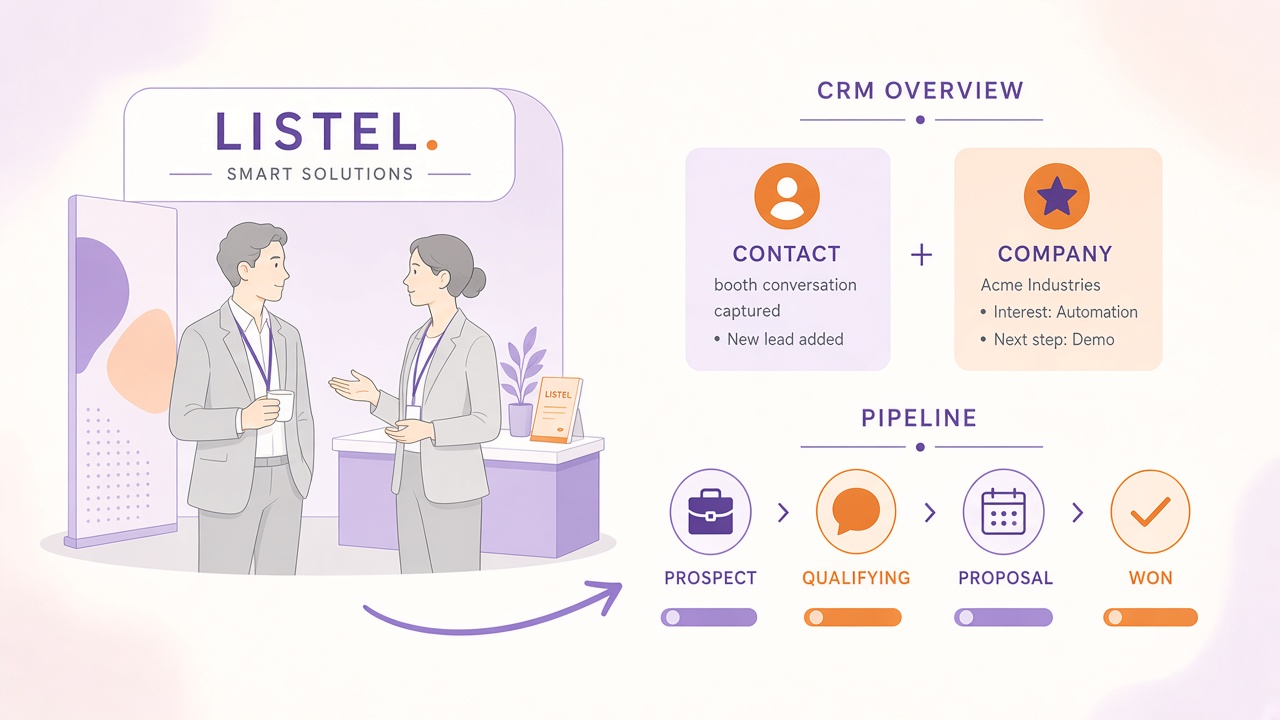
Event spend becomes pipeline when in-person conversations land in CRM as structured data: who you talked to, what they said, and the next step. Badge scans capture the contact. They do not capture the conversation. That is why booth budgets look busy and forecasts still miss. A hands-free wearable that records floor talk and syncs it to CRM is how conference teams close the gap.
Why do trade show conversations evaporate after the badge scan?
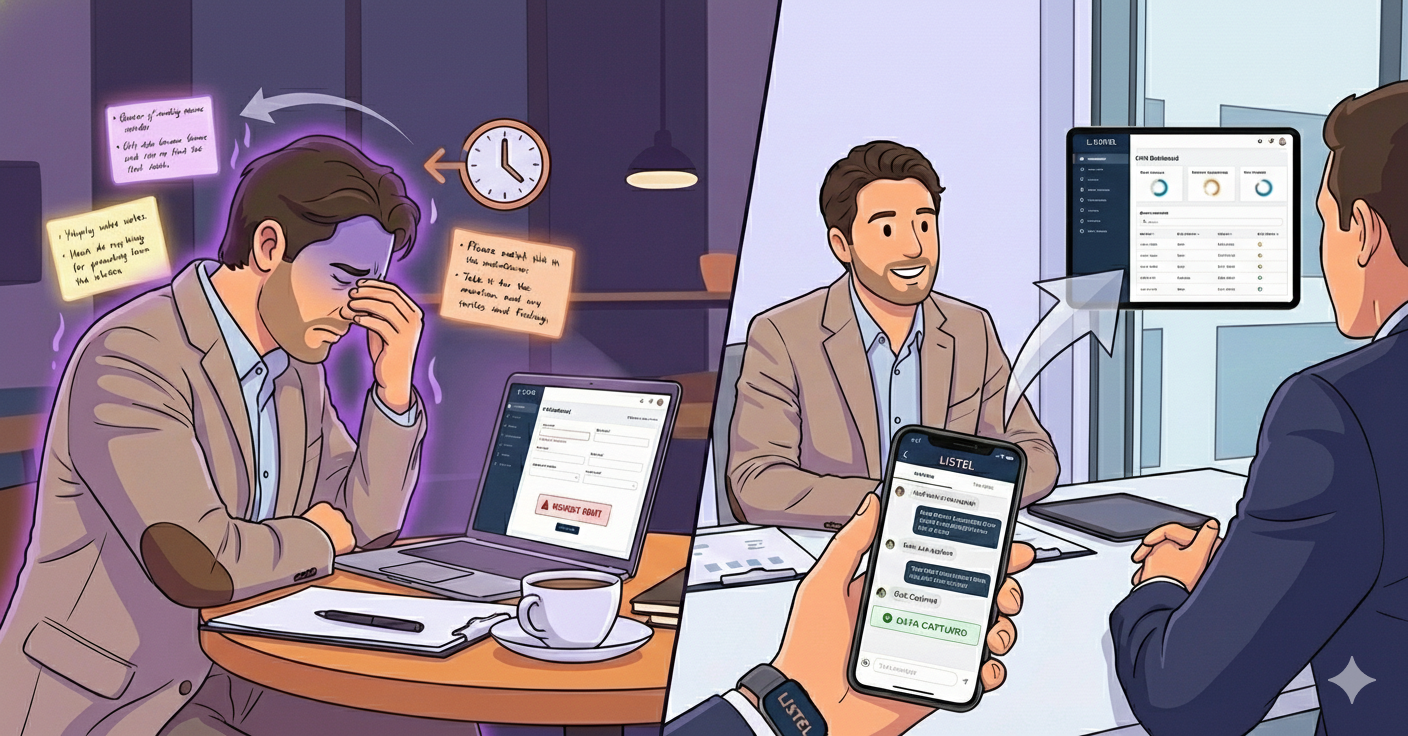
Because the system of record stops at identity. A scan puts a name in a list. The buying signal lived in the rest of the talk: need, timing, objection. Reps cannot type that on a noisy floor. By the hotel that night, the details are gone. CRM gets a lead. Pipeline gets a guess.
You paid for the booth and the people who can hold the conversation. Then you asked them to be data-entry clerks between meetings. They will not do both well. RevOps opens a CSV of scans and builds a sequence. Follow-up goes generic because the reason for the follow-up never made it into the system. That is Memory Drift, compressed into a show week.
Event lead-capture tools get the handoff. Desk conversation intelligence gets the Zoom. You still need the floor talk in CRM. Compare those categories against Listel if you already own one of them.
What should event ROI actually measure?
Measure qualified pipeline you can trace to a floor conversation, with enough context to follow up. Scan counts, booth traffic, and "leads collected" are easy to put in a readout. They do not tell you which talks should become opportunities, or what to say in the first email.
If you own the budget, the QBR question is: what did we get for putting people in the room? You need a record that survives the show.
| Floor reality | Typical artifact | What a VP can actually use |
|---|---|---|
| Badge tap | Name, company, lead source | A list. No qualification. |
| Booth conversation | Whatever the rep typed later, if they typed | Uneven notes. Hard to forecast from. |
| Hallway or dinner follow-on | Usually nothing | Deal context is gone. |
| Wearable capture, CRM-synced | Who, what was said, commitments in CRM | A pipeline story you can defend. |
Volume metrics can stay. They stop being the proof.
How is conversation-derived lead intelligence different from a contact list?
Contact tools enrich a name from public data after a tap. Conversation-derived intelligence comes from what the person said in the room. Need, timeline, objection, next step. That signal is specific to your talk, so scoring and follow-up can be real.
This is the first ROI pillar. Higher-signal than a lookup because it is derived from what happened in front of your team.
A scan tells you they walked by. The conversation tells you they are replacing a vendor in Q4, they have budget, and they want the integration one-pager sent to ops. One record produces a spray sequence. The other produces a deal motion. You can keep the scanner. You still need the talk.
How do conversations get into CRM without making reps type?
Capture has to happen during the conversation, hands-free, then get structured (people, topics, commitments) and written to CRM. If the workflow is "type it after the show," you will get incomplete records. Listel is built for that capture. Wear it and talk. The notes and contacts show up afterward.
This is the second ROI pillar. Manual entry is where event ROI dies. A show floor does not include a quiet hour for Salesforce.
Hands-free matters. A phone held up to someone's face ends the conversation you came to have. The output has to be team-usable: contacts and next steps, via export or a CRM connector depending on plan.
Conference Mode is the volume version of that: booth and hallway conversations, organized and searchable while you are still on site, with a lead list for whoever owns follow-up.
What does this look like for a conference team, not a single rep?
Equip the floor as a unit. You need a team view of who spoke with whom, what was promised, and which conversations are follow-up ready before the flight home. Individual transcripts in a personal notetaker do not give the person who paid for the booth an ROI story.
A workable motion:
- Night before: devices charged, app paired, a 30-second test recording.
- On site: wear it for booth duty and the talk after the scan.
- Same day: review summaries, tag people, send follow-up that quotes what they asked for.
- After the show: CRM reflects the conversations, not a cleaned-up badge file.
The booth bought access. The conversation is the asset. CRM is where it has to live if anyone other than the rep will use it. See the product. If you own a scanner or a desk CI tool, start at the compare hub.
FAQ
Do we still need a badge scanner if we capture conversations?
Often yes, for high-traffic identity capture at the booth. Scanners and digital cards are fast at the handoff. They do not record what was said. Use them for the name. Use conversation capture for qualification and follow-up.
Can this sit next to our call-recording or conversation intelligence stack?
Yes. Desk tools cover video and phone. They do not cover the floor. Keep them for the digital motion. Add a wearable capture layer for in-person event talk, then let both land in CRM.
How soon after the show should CRM be complete?
Same day. Every night of lag is Memory Drift. If notes wait for the office on Monday, you will follow up like you never met them. Hands-free capture exists so the record is there before the next conversation starts.
How do we handle noisy floors and recording consent?
Show floors are loud. Treat that as a capture-design problem. Listel is built to record in that environment, with a visible LED so recording is not hidden. Consent and notice rules vary by place. Align with legal on what your team says and where you record. This FAQ is not legal advice.
Who on the team should wear a device?
Anyone whose conversations you will be asked to turn into pipeline: booth staff, execs walking the floor, partner managers taking dinners. The buyer is the leader who owns event ROI. The users are the people doing the talking.
Get the conversations into CRM
If you already spend to put a team in the room, the next question is whether those talks become pipeline you can see. See how Listel captures who you talked to and what was said, then compare it with the tools you already have.