Pocket Alternative for Sales: Why Personal AI Recorders Fall Short in Field Sales
Pocket is a personal AI recorder that captures conversations and turns them into notes, summaries, and action items. It does that well. But if you're evaluating it for a field sales team, you're about to discover a gap that no amount of transcription quality can close.
The gap isn't the microphone. It's everything that happens after the recording stops.
What Pocket Does Well
Credit where it's due. Pocket built a clean, screen-free device that records conversations with a single press. The transcription is solid, speaker identification works, and the AI summaries are genuinely useful for personal note-taking. If you're a founder trying to capture ideas on the go or a student recording lectures, it's a smart choice.
But field sales isn't personal note-taking. It's a team sport with a data pipeline attached.
Where the Workflow Breaks for Sales
Your rep finishes a meeting with a prospect. Pocket captured the conversation. Good. Now what?
The rep opens the Pocket app, reads through the summary, and... copies the relevant bits into HubSpot? Opens Salesforce on their phone and manually creates an activity? That's the same workflow that was already breaking before the recorder entered the picture. The bottleneck was never "I don't have a transcript." The bottleneck is getting conversation context into the CRM without adding steps to the rep's day.
Pocket gives you a transcript. Your CRM needs structured data—contact associations, deal updates, next steps, objection flags. A transcript sitting in a separate app doesn't solve that. It just moves the manual work from "remember and type" to "read and copy-paste."
The Consumer vs. Sales-Specific Gap
This isn't a knock on Pocket's engineering. It's a product design question. Pocket was built for consumers who want a personal AI assistant. That means:
No native CRM sync
Pocket keeps your data in its own ecosystem. For personal use, that's fine. For sales, it means your conversation data lives in a silo—disconnected from the deals, contacts, and pipeline that your team actually operates in. The result looks a lot like what happens when CRM systems fail in field sales: the data exists somewhere, but it never reaches the system of record.
No sales-specific AI structure
Pocket's AI produces general summaries and action items. It doesn't know what a buying signal looks like, doesn't flag objections, doesn't extract next steps in a format your sales process can consume. Field sales conversations have a structure that generic transcription misses—and that structure is exactly what makes conversation data useful downstream.
No team analytics
Pocket is a single-player tool. There's no manager dashboard, no team-level conversation trends, no way for a sales leader to see what's happening across 15 reps in the field. If you're a sales manager trying to coach with real data instead of ride-along impressions, a personal recorder doesn't give you the visibility you need.
No enterprise compliance controls
When you're recording conversations in B2B field sales—especially in regulated industries like medical device or pharma—you need configurable privacy controls, consent workflows, and audit trails. Consumer devices aren't built for that level of governance.
Why "Good Enough" Isn't
It's tempting to think: "We'll just buy everyone a Pocket and figure out the CRM piece later." Teams try this. Here's what happens:
Week one, reps are excited. They record everything. Summaries pile up in the Pocket app. A few diligent reps copy notes into the CRM. Most don't.
Week three, the novelty fades. The Pocket app has dozens of recordings. The CRM has the same sparse entries it always had. Management still can't see what's happening in the field. The context decay problem didn't go away—it just got a new app icon.
The issue isn't rep discipline. It's workflow design. If capturing a conversation and getting it into your pipeline requires multiple apps and manual steps, the data won't flow. Not because reps are lazy, but because that's not how field sales works.
What Field Sales Actually Needs
The job isn't "record conversations." The job is: capture what happens in the field, structure it for your sales process, and get it into the systems your team runs on—without adding friction to the rep's day.
That means the capture tool needs to understand sales context, not just audio. It needs to push data to your CRM automatically, not wait for a rep to open a second app. And it needs to surface team-level patterns, not just individual transcripts.
How Listel Approaches This
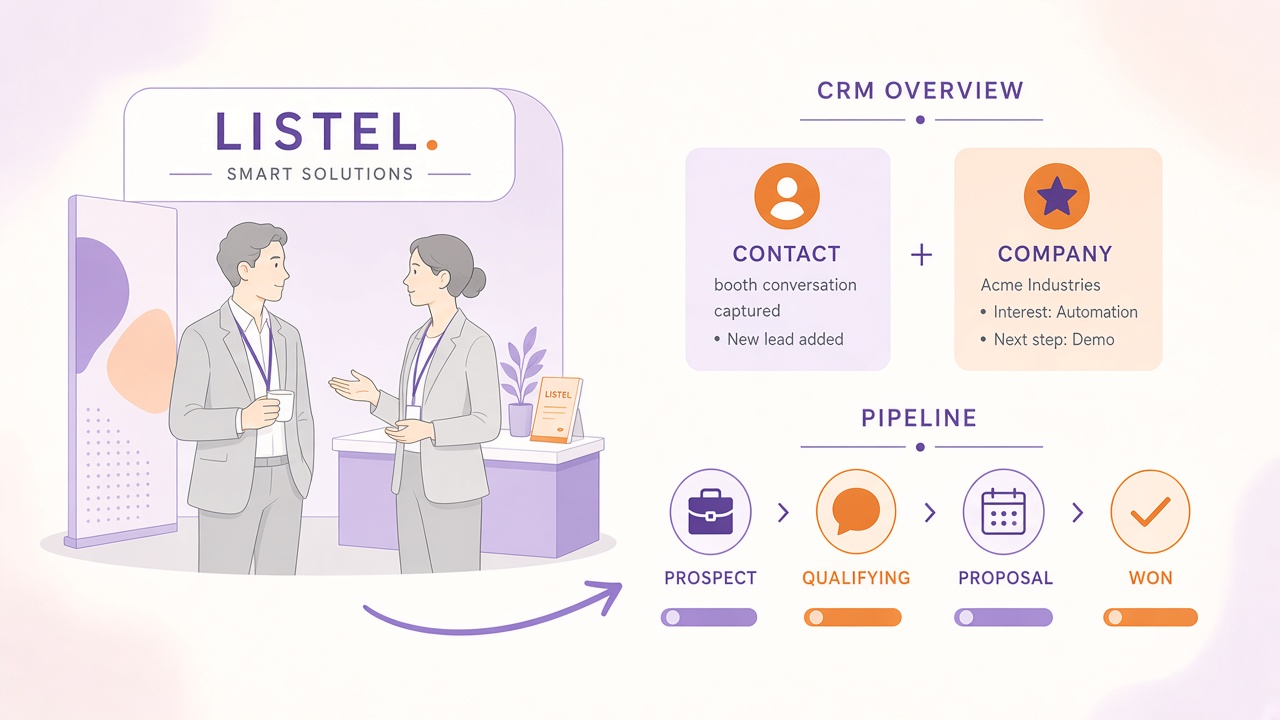
Listel is built for exactly this job. The wearable captures in-person conversations hands-free—same as Pocket. But what happens after the recording is where the design diverges completely.
Listel's AI doesn't just transcribe. It structures conversations into sales-relevant data: key moments, objections, next steps, and deal context. That structured data syncs directly to your CRM—HubSpot, Salesforce, whatever your team uses—without the rep lifting a finger after the meeting ends.
For sales leaders, Listel provides team analytics and conversation trends across your entire field org. You can see what objections are coming up most, which reps are capturing the richest context, and where deals are stalling—all from conversations that used to disappear the moment the rep walked out the door.
It's the difference between a recorder and a sales data layer. Pocket gives you the recording. Listel gives you the pipeline intelligence.
Key Takeaway
The best field sales tools don't just capture audio—they capture context and move it into the systems your team already uses. If your recorder can't sync to your CRM, structure data for your sales process, and give your managers visibility, it's a personal tool doing a team job.
For a detailed feature-by-feature breakdown, see how Listel compares to Plaud.AI as an enterprise alternative.