Stop Blaming Reps: Is Your CRM Actually Accurate?
CRM data is often inaccurate because we rely on human memory to fill the gaps—not because reps are bad at their jobs. The mechanisms that capture sales interactions can't keep pace with how fast teams operate.
In the fast-paced world of sales, nothing is more disheartening than realizing that your CRM—a supposed single source of truth—might be riddled with fake news and false information. Sales teams often operate under the assumption that the data in their CRM reflects reality. But what happens when that data is built on assumptions and false memory?
The real issue isn't the capabilities of the CRM itself; it's how we've come to rely on human memory to fill in the gaps. Sales reps are great at building relationships and closing deals, but they are not always equipped to provide a perfect recall of every interaction. This reliance on memory can lead to inflated assumptions about the CRM's accuracy, masking compounding data issues.
This is not a blame game. Instead of pointing fingers at your reps, consider the bigger picture. The mechanisms designed to capture and record sales interactions are failing to keep pace with human behavior, especially at the speed teams are operating in the AI age. This creates a distorted view of the sales pipeline. The same workflow mismatch that hurts CRM adoption drives inaccurate data—and so does context loss in field sales.
Where it breaks
The problem lies in the workflow surrounding CRM data entry. Sales teams typically rely on immediate updates to the CRM post interaction. But factors such as the number of transactions, the pressure to close deals, and the sheer volume of daily activities create a timing constraint. A rep might finish a meeting, make a note in their notebook, and then forget to input the details into the CRM.
Picture this: a rep comes back from a meeting with a prospect who expressed tentative interest in a product upgrade. Instead of detailing the conversation in the CRM, they only note "interested." Fast forward a week, and that prospect has been regularly nudged by the sales team, who believe there's a high likelihood of closure. The team is misled by the oversimplified note, and then spend a disproportionate amount of effort on something that may never close.
Why the usual fixes fail
Sales leadership often resorts to familiar fixes like mandatory CRM training sessions or increased oversight. But such measures only scratch the surface. Training may not account for the uniqueness of each rep's style, nor does it address the issue of memory being replaced with simple notes.
Another common approach is implementing more "reminder" systems. While reminders help, they still require action from the rep—the same action that often gets overlooked in the first place. These quick-fix solutions miss the point: the sales process is ultimately dictated by human behavior, which is not easily manipulated by additional notifications.
Lastly, some organizations consider more complex software solutions, dreaming of a one-size-fits-all approach. These systems often create additional layers of complexity and don't fix the root issue of human recall over systematic documentation, ultimately leading to more frustration.
The failure mode
We call this the "Memory Gap." It's a pattern where human memory attempts to compensate for inadequate data capture. Reps remember only fragments of conversations, how opportunities were formed, or why a particular deal went cold. This gap leads to unreliable data, causing cascading inaccuracies throughout the sales process.
What better design looks like
So, what does a better-designed system look like? A system that anticipates human behavior rather than trying to regulate it. For instance, integrate bite-sized, context-aware prompts into the workflow that guide reps on what to capture immediately after a call. Think of these as small, frictionless reminders for reps of essential details rather than overwhelming them with a long list of requirements.
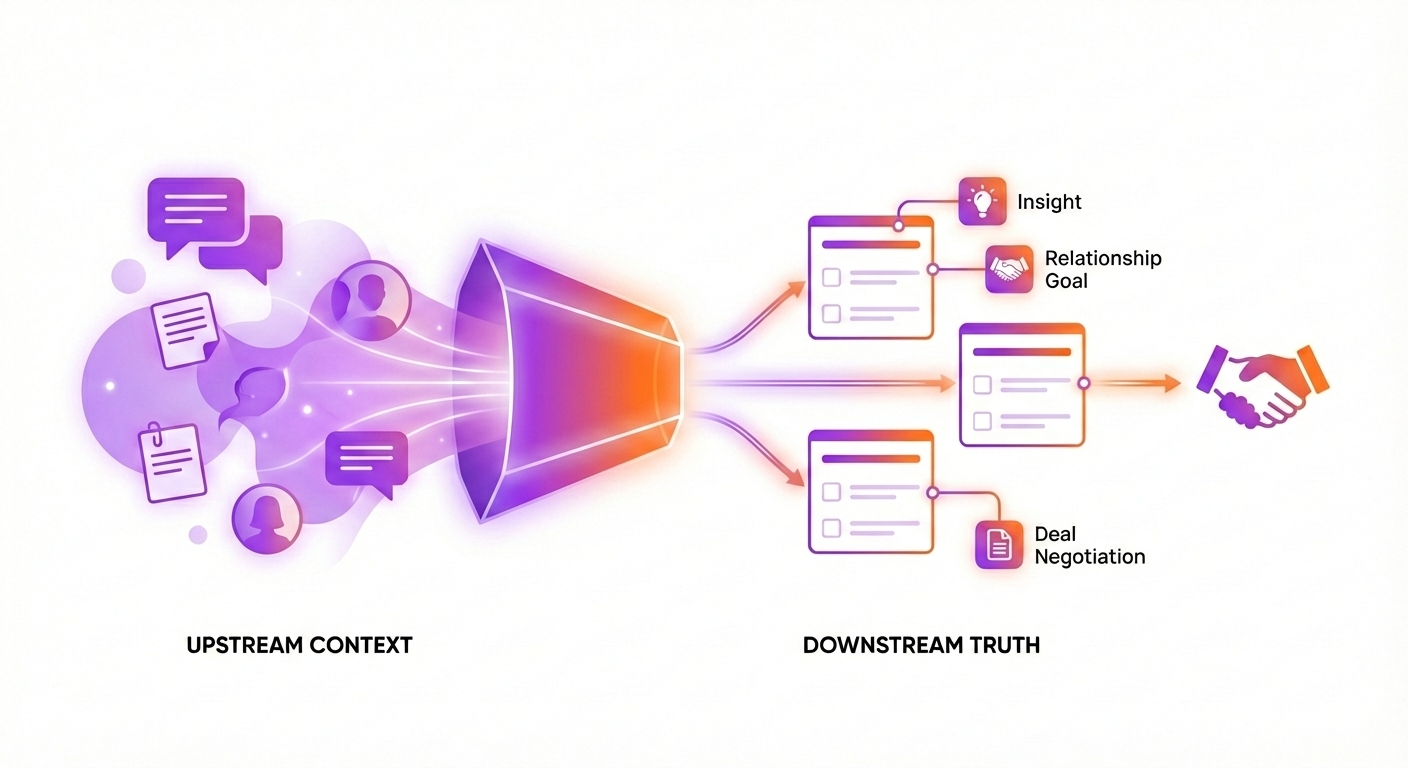
Additionally, streamline upstream capture to lead you toward downstream truth. This could mean integrating your CRM with communication tools, enabling automatic logging of meeting summaries or critical action items, reducing the cognitive load on reps.
By transforming CRM systems in this way, organizations can foster an environment where data is both more reliable and easier to capture, reducing reliance on memory entirely.
Where Listel fits
This is where Listel can make a tangible difference. Our approach emphasizes the critical connection between upstream capture and downstream truth. By simplifying data entry through intuitive CRM integrations, we help sales teams focus on what really matters: building relationships and closing deals, instead of wrestling with data accuracy.
Our wearable captures the data where it happens, and allows teams to leverage their own conversational data layer in the CRM or anywhere else downstream it can be leveraged.
The objective is clarity. With the right tools, all sales interactions become an accurate reflection of reality, free of the discrepancies that arise from flawed memory recall.
Takeaway
"When you treat your CRM as a living document, you empower your teams to be more than just data entry clerks—they become informed strategists."
Want to see how Listel compares to tools like Salesloft that approach conversation intelligence from a virtual-first perspective? The gap between virtual and in-person capture is where most field teams lose data.